
Death Tarot Card
The card of transformation, endings, and profound renewal
Overview
The Death card is the most feared and most misunderstood card in the entire tarot deck. When it appears in a reading, many people feel a surge of anxiety — but seasoned tarot readers know that this card rarely signifies physical death. Instead, Death represents the most profound kind of transformation: the complete ending of one chapter so that an entirely new one can begin.
As card number 13 in the Major Arcana, Death carries the energy of deep, irreversible change. This is not a minor adjustment or a temporary setback — it's a fundamental shift in your identity, circumstances, or worldview. The caterpillar doesn't modify itself into a butterfly; it dissolves completely and rebuilds from scratch. That is the energy of the Death card. What emerges from this transformation will be more authentic, more aligned, and ultimately more beautiful than what came before.
When Death appears in your reading, something in your life has reached its natural conclusion. A relationship, a career path, a belief system, a phase of personal development — whatever it is, the universe is signaling that holding on will only create suffering. The most empowering response to the Death card is willing surrender: let go of what's ending, grieve what needs to be grieved, and trust that the space created by this loss will be filled with something extraordinary.
Card Symbolism
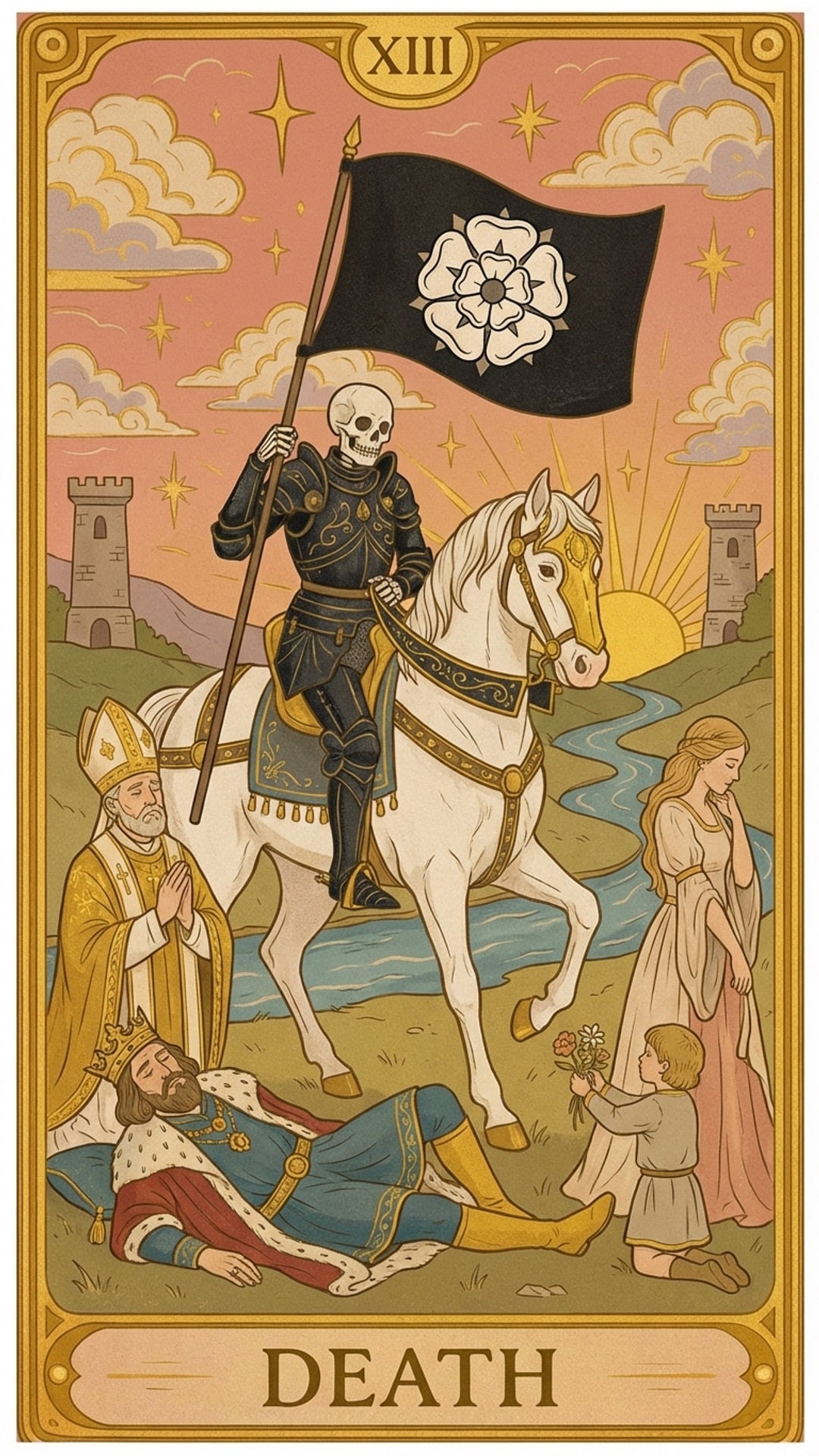
The Death card's imagery is deliberately dramatic, designed to convey the magnitude of the transformation it represents. A skeletal figure rides a white horse, moving steadily forward through a landscape where figures of all social stations — kings, clergy, children — either bow or fall before it. This imagery communicates a fundamental truth: transformation spares no one. Regardless of your wealth, status, or power, change is the one constant that applies equally to all.
The white horse symbolizes purity and spiritual power. Death's movement is not violent or chaotic — it is calm, steady, and inevitable. The skeleton wears black armor, representing the impenetrable nature of transformation: you cannot negotiate with it, bargain your way out of it, or avoid it through cleverness. You can only surrender and allow the process to unfold.
The black flag carried by the figure bears a white rose — a symbol of beauty, purity, and renewal emerging from darkness. This is the card's most hopeful element: even in the imagery of endings, the promise of new life is present. The rising sun on the horizon reinforces this message — dawn always follows the darkest night.
The river flowing in the background represents the constant flow of life energy and the emotional currents that carry us through periods of change. The two pillars in the distance echo the gateway imagery found in other Major Arcana cards, suggesting that Death is a threshold — a passage between what was and what will be.
Upright Meaning
When Death appears upright, a significant transformation is either underway or imminent. This is not a card of subtle change — it signals the kind of shift that fundamentally alters the landscape of your life. An old identity is dying so that a new, more authentic version of yourself can emerge. The process may be uncomfortable, but it is absolutely necessary.
The Death card upright asks you to identify what in your life has outlived its purpose. Perhaps you're clinging to a relationship that no longer nourishes you, staying in a career that crushes your spirit, maintaining habits that undermine your health, or holding onto beliefs that were useful once but now limit your growth. Whatever it is, the Death card says: it's time to let go.
Resistance is the primary source of suffering when this card appears. The transformation will happen regardless of whether you cooperate — the question is whether you'll move through it gracefully or be dragged through it kicking and screaming. Choose surrender. Choose trust. Choose the understanding that every great renewal in history required the courage to release what came before.
The Death card upright also carries a message of liberation. On the other side of this ending lies freedom — from outdated patterns, toxic dynamics, limiting self-concepts, and everything else that has been keeping you small. The transformation may feel like loss in the moment, but with time you'll recognize it as one of the most important passages of your life.
Reversed Meaning
Death reversed indicates that you're resisting a necessary transformation. The change that needs to happen is being postponed, denied, or actively fought against — and this resistance is creating stagnation, anxiety, or a sense of being trapped. You know, on some level, that something needs to end. But fear of the unknown, attachment to the familiar, or simple stubbornness is keeping you locked in a situation that has already expired.
This reversal often appears when people are staying in relationships, jobs, or living situations long past their expiration date. The comfort of the known — even when that "comfort" involves daily unhappiness — feels safer than the uncertainty of walking away. Death reversed is the universe tapping you on the shoulder and saying: the longer you delay this, the harder it becomes.
Another dimension of Death reversed is incomplete transformation. You may have begun the process of change but stopped halfway, leaving yourself in a liminal space that is neither the old reality nor the new one. This in-between state is draining. The card encourages you to commit fully to the transformation — don't try to carry pieces of the old life into the new one if they don't belong there.
In some readings, Death reversed can also indicate an inner transformation that hasn't yet manifested externally. Your beliefs, values, or sense of self may have shifted dramatically, but your outer circumstances haven't caught up yet. Be patient with this process, but also be honest about what practical changes need to happen for your inner evolution to be reflected in your daily life.
Love & Relationships
In love readings, the Death card carries profound significance. Upright, it signals that a major shift is happening in your romantic life — and while this may initially feel frightening, the result will ultimately be liberating. The nature of this shift depends on your specific situation.
For singles, Death often means the end of old romantic patterns. Perhaps you've been attracted to the same type of unavailable partner for years, or maybe you've been carrying grief from a past relationship that prevents you from opening your heart fully. The Death card says: that chapter is closing. The version of you that kept repeating those patterns is transforming into someone who is ready for a healthier, more fulfilling connection.
For couples, the Death card can signify several things. It may indicate the natural evolution of a relationship — from casual dating to committed partnership, from newlywed excitement to deeper mature love, or from partnership to co-parenting. These transitions require letting go of what the relationship used to be in order to embrace what it's becoming. In more challenging cases, Death in a couple's reading can signal that the relationship itself is ending, and that both partners will ultimately be better served by parting ways.
Reversed in love, Death warns against clinging to relationships that have clearly run their course. If you're staying out of fear, obligation, or simply because you don't know who you are without this person, the reversed Death card is your call to courage. Ending a relationship that no longer serves either partner is an act of love — for both of you.
Career & Finances
In career readings, the Death card signals a major professional transformation. Upright, this could manifest as leaving a long-held position, changing industries entirely, closing a business, or experiencing a significant restructuring in your workplace. The common thread is that the professional identity you've held is evolving into something new.
This card often appears when people have outgrown their current role but are afraid to make the leap. If you've been fantasizing about a career change for months or years, Death's appearance confirms what you already know: it's time. The security of your current position is an illusion if it comes at the cost of your passion, growth, and authentic self-expression.
For entrepreneurs, the Death card can signal a pivot moment — the need to let go of a product, service, or business model that once worked but no longer generates results. Successful businesses reinvent themselves constantly, and Death reminds you that clinging to what worked in the past is the surest path to irrelevance.
Financially, Death suggests a period of restructuring. Old financial habits, spending patterns, or income sources may be changing. While this transition might feel uncomfortable, it's an opportunity to build a healthier, more sustainable relationship with money. Avoid making major financial decisions during the peak of this transformation — wait for the dust to settle and clarity to emerge before committing to new financial strategies.
Advice
The Death card's advice is one of the most powerful in the entire tarot: surrender to what is ending. Stop fighting the current of change and trust that the universe is clearing space for something better. The grief you feel is real and valid — honor it. But don't let grief become an anchor that keeps you bound to a shore you were meant to leave.
Practice conscious release. Identify one thing in your life that you know, deep down, has run its course. Acknowledge its value, thank it for what it taught you, and then let it go. Transformation is not a punishment — it is the mechanism through which life renews itself. You are not losing something; you are making room for what comes next.
Yes or No
Death leans toward No — but not in the way you might fear. This card suggests that the situation you're asking about is not meant to continue in its current form. The answer isn't simply "no, it won't happen" — it's "no, because something needs to change first."
If you're asking whether to hold onto something, the Death card says release it. If you're asking whether a new beginning is coming, the answer is yes — but only after the necessary ending occurs. The Death card doesn't close doors permanently; it closes the ones that need closing so the right ones can open.
Frequently Asked Questions About The Death Card
Does the Death tarot card mean actual death?
No — the Death card almost never predicts physical death in a tarot reading. This is the single most misunderstood card in the entire deck. Death represents transformation, endings, and the natural cycle of change that makes room for new growth. Just as autumn leaves must fall for spring blossoms to emerge, the Death card signals that something in your life needs to end so something better can begin. Experienced tarot readers view this card as one of the most positive in the deck because it promises deep, meaningful renewal.
What does the Death card mean in a love reading?
In love, the Death card signals a significant transformation in your romantic life. For singles, it often means letting go of old relationship patterns, past heartbreaks, or unrealistic expectations that have been blocking new love. For couples, it can indicate the end of one phase and the beginning of another — which might mean deepening commitment, renegotiating the relationship's terms, or in some cases, recognizing that the partnership has run its course. The key message is that resisting this change will only prolong suffering.
Is the Death card a yes or no?
The Death card is generally a 'no' in yes-or-no readings, but with important nuance. It suggests that the situation you're asking about needs to end or transform rather than continue in its current form. The Death card doesn't deny future possibility — it says that what you're asking about in its present state isn't meant to last. Sometimes a 'no' from the Death card is actually a gift, clearing the path for something far more aligned with your authentic self.
What zodiac sign is associated with the Death card?
The Death card is associated with Scorpio, the zodiac sign ruled by Pluto — the planet of transformation, death, and rebirth. This connection runs deep: Scorpio energy is all about profound change, psychological depth, and the willingness to confront uncomfortable truths in order to evolve. Like Scorpio, the Death card operates beneath the surface, working on the deepest levels of consciousness to facilitate genuine transformation rather than superficial change.
What comes after the Death card in the Major Arcana?
After Death (card 13) comes Temperance (card 14), which represents balance, patience, and integration after a period of intense transformation. This sequence is deeply meaningful: once the Death card has cleared away what no longer serves you, Temperance arrives to help you find equilibrium in your new reality. It suggests that after every significant ending, there is a period of healing and harmonization where the lessons of transformation are absorbed and integrated into your being.