
Eight of Swords Tarot Card
The card of limiting beliefs, self-imposed restraint, and the prison of the mind
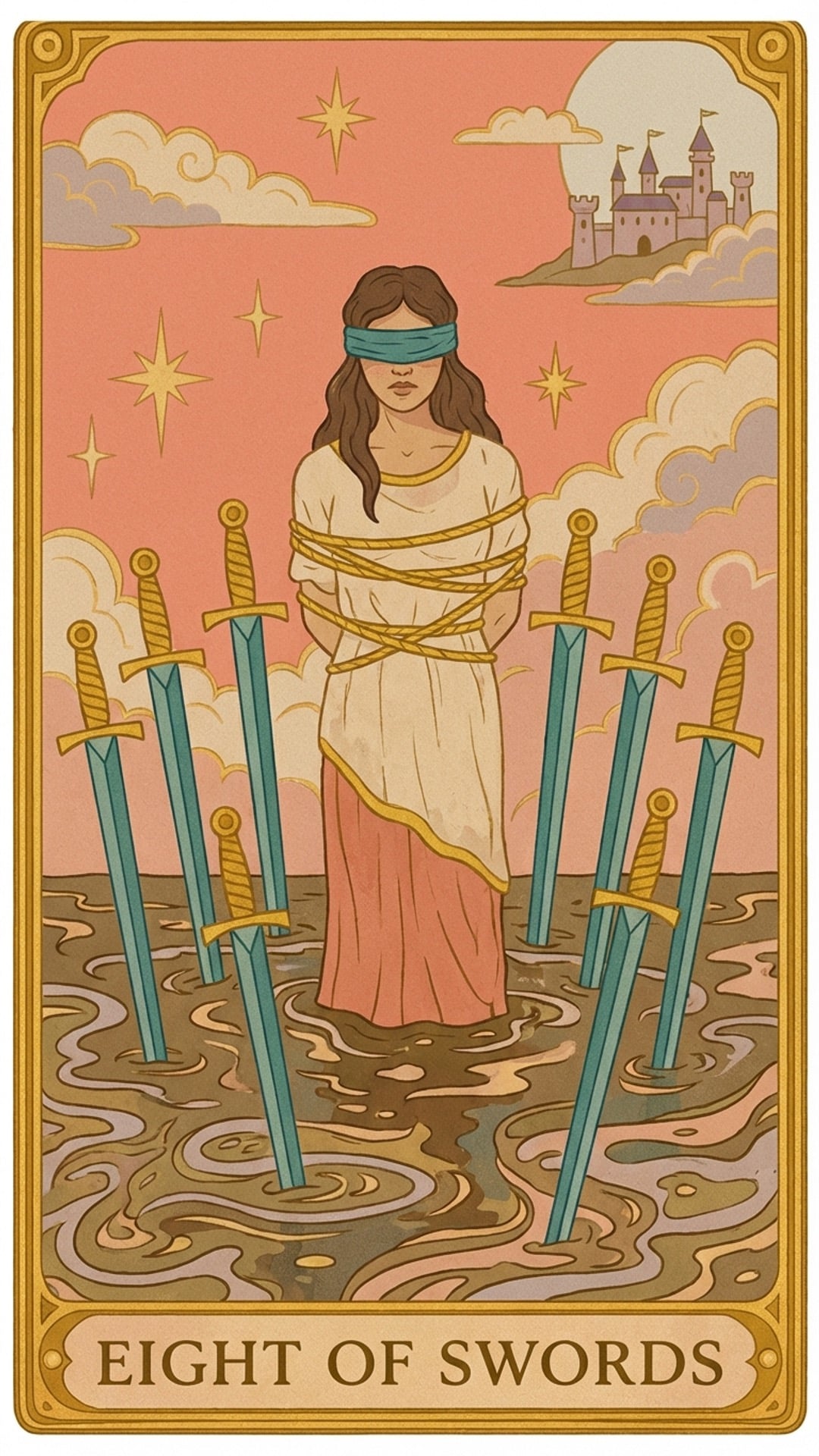
Overview
The Eight of Swords is the tarot's portrait of the prison of the mind. A figure stands bound and blindfolded, surrounded by eight swords planted in the ground. The image suggests captivity — and yet, in many decks, a closer look reveals that the bindings are loose, the blindfold could be removed, and the swords do not fully enclose the figure. There may be a gap. There may be a way out.
When the Eight of Swords appears in your reading, you are being invited to question your sense of powerlessness. Do you truly have no options? Or have you convinced yourself that you don't? The card speaks to the human tendency to create mental prisons — to tell ourselves stories of limitation that feel so real we stop testing them.
The Eight of Swords does not deny that real obstacles exist. It simply suggests that we often add to them with our thoughts. The first step toward freedom is to question the story we tell ourselves.
Card Symbolism
The Eight of Swords typically shows a figure — often a woman — bound with rope and blindfolded, standing in a circle of eight swords. The swords are planted in the ground, points up, creating a barrier. Yet the barrier is not complete; there are often gaps. The bindings are sometimes loose enough that the figure could free themselves with effort.
The blindfold is significant. We cannot see our way out when we refuse to look — or when we've convinced ourselves that there is nothing to see. The blindfold can represent the limiting beliefs that obscure our vision: I can't, I'm stuck, I have no choice.
The number eight in tarot often relates to power, movement, and the infinite. In the Eight of Swords, this energy is inverted: we have the power to move, but we've convinced ourselves we don't. The infinity symbol, when turned on its side, becomes the number eight — suggesting that the cycle of limitation can be broken when we shift our perspective.
Upright Meaning
When the Eight of Swords appears upright, you may be experiencing a sense of being trapped. You may believe that you have no options, that circumstances have you bound, or that you're powerless to change your situation. The card invites you to examine that belief.
Often, the Eight of Swords appears when we've internalized limiting messages — from our past, from others, or from our own fears. We've built a prison in our minds and then mistaken it for reality. The card does not say that your situation is easy; it says that you may have more agency than you believe.
The Eight of Swords can also indicate a victim mentality — the tendency to see ourselves as powerless when we might have choices we haven't considered. This is not a judgment; it's an invitation. What would it mean to try? What would it mean to question the story?
Reversed Meaning
The Eight of Swords reversed suggests that you are breaking free. The bindings are loosening; the blindfold is slipping. You're beginning to see options that you didn't see before, and to recognize that you have more power than you believed.
This reversal can indicate a shift in perspective — the realization that you've been telling yourself a story of powerlessness that isn't fully true. It may also indicate that external circumstances are changing, and that what once seemed impossible is now within reach.
The reversed Eight of Swords encourages you to take the first step. Try. Move. Question. You are not as trapped as you thought. In some cases, the reversal warns against swinging to the opposite extreme: don't dismiss real obstacles, but don't let perceived obstacles hold you back either. The goal is balanced awareness — seeing both the real constraints and the real possibilities.
Love & Relationships
In love readings, the Eight of Swords often indicates that you feel trapped — in a relationship, or in the absence of one. You may believe that you have no options: you must stay in an unhappy situation, or you're destined to be alone. The card invites you to examine these beliefs.
For singles, the Eight of Swords can suggest a mental prison around love. Perhaps you've decided that no one could want you, that all relationships end in pain, or that you're too damaged to be loved. These beliefs can become self-fulfilling. The card invites you to question them. What evidence do you have? What would change if you believed differently?
For those in relationships, the Eight of Swords may indicate feeling stuck — but the bindings may be looser than they appear. What would it mean to communicate your needs? To seek couples therapy? To leave if change is not possible? The card reminds you that you have more agency than you think. The first step is often naming what you want — and then testing whether it's truly impossible.
Career & Finances
The Eight of Swords brings the energy of perceived limitation to career readings. You may believe that you're stuck in your job, that you have no other options, or that your circumstances prevent you from making a change. The card invites you to question that belief.
What would it mean to look for another position? To develop new skills? To ask for what you need? Sometimes we stay in unsatisfying situations because we've convinced ourselves we have no choice — when in fact we've simply not tried. The Eight of Swords does not promise that change is easy; it suggests that it may be more possible than you think.
Financially, the Eight of Swords may indicate a sense of being trapped by money — by debt, by circumstances, or by beliefs about what's possible. The card invites you to seek information: What are your actual options? What would a financial advisor say? Sometimes the prison is partly built from lack of knowledge. Education can be a key to the door.
Advice
The Eight of Swords advises you to question your assumptions. What story are you telling yourself about your situation? Is it true? What would happen if you tried to move?
Start small. You don't have to make the big leap immediately. What's one step you could take? One option you could explore? One belief you could test? The Eight of Swords often persists because we've stopped testing. We've accepted the prison as real without checking if the door is locked.
Seek support if you need it. Sometimes our limiting beliefs are deeply ingrained, and a therapist, coach, or trusted friend can help us see what we cannot see alone. There is no shame in asking for help to find the gap in the swords.
Finally, remember that the bindings in the card are often loose. The blindfold can be removed. You may have more freedom than you believe. The first step is to look.
Yes or No
The Eight of Swords is generally a No — but with a caveat. The no may not reflect the actual situation; it may reflect your belief that the answer is no. You may be limiting yourself, seeing obstacles that aren't there, or telling yourself that you have no choice when you do.
Before accepting a no, the Eight of Swords invites you to question: Is this really impossible, or does it feel impossible? In reversed position, the answer may shift toward yes — you're breaking free from limiting beliefs, and you're beginning to see options. Trust that shift.
Frequently Asked Questions About the Eight of Swords
What does the Eight of Swords tarot card mean in a reading?
The Eight of Swords represents limiting beliefs, self-imposed restraint, and the experience of feeling trapped — often by our own thoughts. When this card appears, you may believe that you have no options, that you're powerless, or that circumstances have you completely bound. The card typically depicts a figure bound and blindfolded, surrounded by eight swords — yet in many decks, the bindings are loose and the swords do not fully enclose the figure. This suggests that the prison may be partly or largely self-created. The Eight of Swords invites you to question your assumptions. What would happen if you tried to move? What if the obstacles you see are not as solid as they appear? The card carries a message of hope: often, we are more free than we believe we are. The first step is to question the story we tell ourselves.
Is the Eight of Swords a yes or no card?
The Eight of Swords is generally a no when it appears in yes-or-no readings — but with an important caveat. The no may not reflect the actual situation; it may reflect your belief that the answer is no. This card suggests that you may be limiting yourself, seeing obstacles that aren't there, or telling yourself that you have no choice when you do. Before accepting a no, the Eight of Swords invites you to question: Is this really impossible, or does it feel impossible? In reversed position, the card can indicate that you're breaking free from limiting beliefs — the bindings are loosening, and you're beginning to see options. In that case, the answer may shift toward yes as you recognize your own agency.
What does the Eight of Swords mean in love?
In love readings, the Eight of Swords often indicates that you feel trapped in a relationship — or trapped by the absence of one. You may believe that you have no options, that you must stay in an unhappy situation, or that you're unlovable and destined to be alone. The card invites you to examine these beliefs. Are they true, or are they stories you've told yourself? For singles, the Eight of Swords can suggest a mental prison around love — perhaps you've decided that no one could want you, or that all relationships end in pain. For those in relationships, the card may indicate feeling stuck — but the bindings may be looser than they appear. What would it mean to communicate your needs? To seek change? To leave if change is not possible? The Eight of Swords reminds you that you have more agency than you think.
What does the Eight of Swords reversed mean?
The Eight of Swords reversed suggests that you are breaking free from limiting beliefs and self-imposed restraint. The bindings are loosening; the blindfold is slipping. You're beginning to see options that you didn't see before, and to recognize that you have more power than you believed. This reversal can indicate a shift in perspective — the realization that you've been telling yourself a story of powerlessness that isn't fully true. It may also indicate that external circumstances are changing, and that what once seemed impossible is now within reach. The reversed Eight of Swords encourages you to take the first step — to try, to move, to question. You are not as trapped as you thought. In some cases, the reversal warns against swinging to the opposite extreme: don't dismiss real obstacles, but don't let perceived obstacles hold you back either.
How can you break free from the Eight of Swords energy?
The Eight of Swords invites a gentle but persistent inquiry. First, name the belief. What story are you telling yourself? I can't leave. I have no options. I'm stuck. Second, question it. Is it true? What evidence do you have? What would someone who loved you say? Third, experiment. What would happen if you tried? Not necessarily the big move — the small one. What if you expressed one need? Explored one option? Took one step? The Eight of Swords often persists because we've stopped testing our assumptions. We've accepted the prison as real without checking if the door is locked. Sometimes the bindings are loose. Sometimes the swords don't fully enclose us. The card invites you to look — and to move. Support from a therapist, coach, or trusted friend can help when the beliefs are deeply ingrained.