
Five of Swords Tarot Card
The card of conflict, defeat, and the bitter taste of hollow victory
Overview
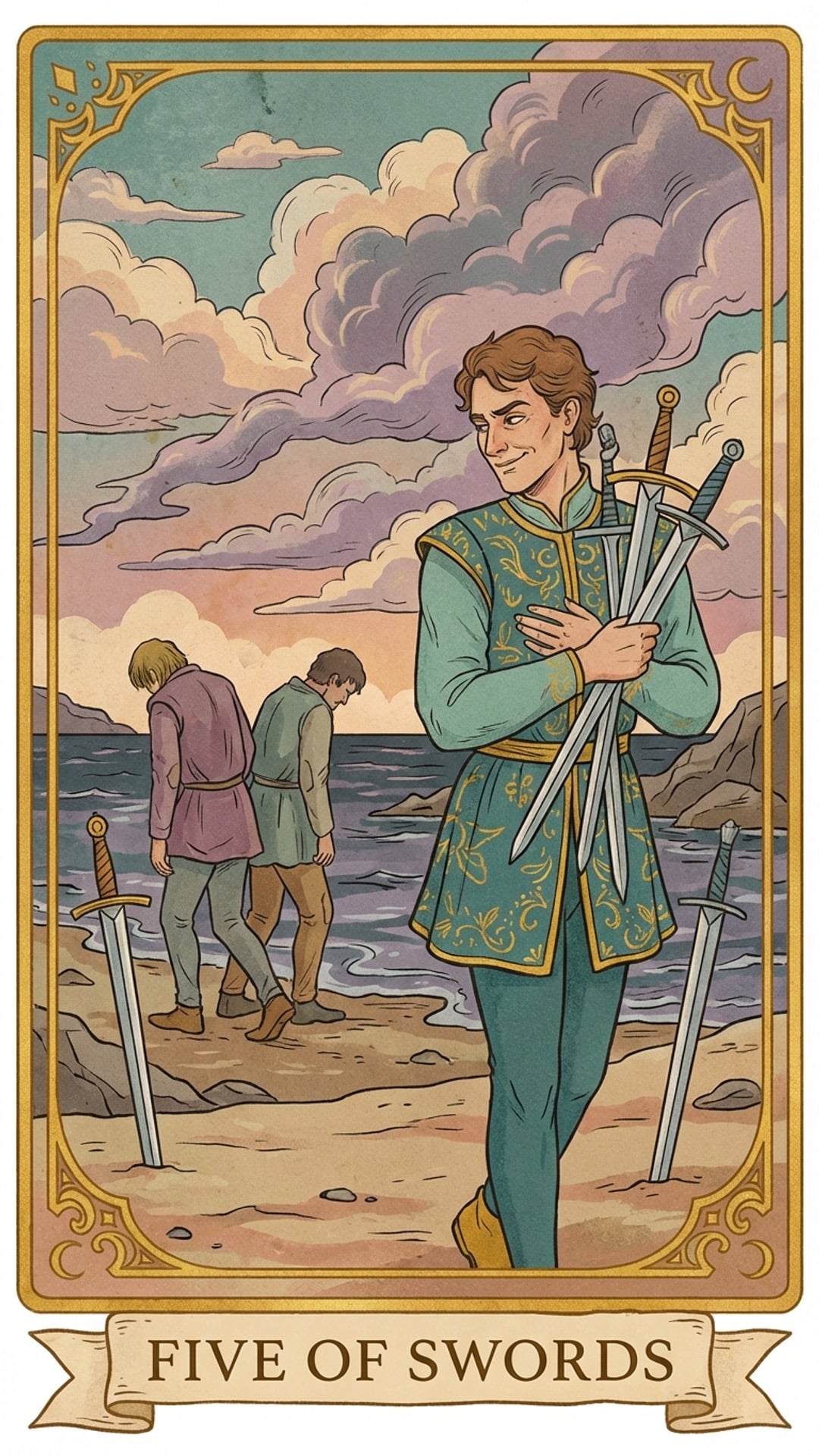
The Five of Swords is the tarot's portrait of conflict and its aftermath. A figure stands triumphant, gathering swords from the ground, while others walk away in defeat. The sky may be stormy; the mood is uneasy. This card captures a difficult truth: sometimes we win, but the victory leaves a bitter taste. We have bested our opponent, proven our point, or defended our position — and in doing so, we have lost something we cannot easily reclaim.
When the Five of Swords appears in your reading, you are being invited to examine the cost of conflict. What did you gain? What did you lose? Was it worth it? The card does not always condemn winning — sometimes we must fight for what is right. But it asks you to look clearly at the aftermath: the broken trust, the wounded relationships, the hollow feeling that can accompany triumph when it comes at too high a price.
The Five of Swords speaks to the shadow side of the Swords suit — the intellect and truth-seeking turned into weapons, the clarity that cuts without care.
Card Symbolism
The Five of Swords typically shows a figure — often smug or triumphant — holding or gathering swords while other figures retreat in defeat. The victor has the swords; the vanquished have nothing. The imagery suggests asymmetry: this was not a fair fight, or the outcome has left a stark imbalance.
The five swords can represent the scattered aftermath of conflict — the debris of battle, the weapons that have been used. The number five in tarot often relates to change, challenge, and the disruption of stability. In the Five of Swords, this disruption is the rupture of peace, the shattering of trust, or the fragmentation of relationship.
The defeated figures walking away suggest loss — not only of the conflict but of connection. The victor stands alone with their swords. The question the card poses: Is this what you wanted? Is this what winning looks like?
Upright Meaning
When the Five of Swords appears upright, you may be in the midst or aftermath of conflict. You may have won — in an argument, a competition, or a power struggle — but the victory feels hollow. You may have used tactics that you're not proud of: manipulation, harsh words, or unfair advantage. The card invites you to sit with that discomfort.
Alternatively, you may have lost. The Five of Swords can indicate defeat, humiliation, or the pain of being on the wrong side of a conflict. You may feel that you were treated unfairly, that the odds were stacked against you, or that you never had a chance. The card acknowledges that loss is real and that it hurts.
In either case, the Five of Swords asks: What now? How do you move forward? Can relationships be repaired? Can you release the need to win or the shame of losing? The card suggests that the true work begins after the battle — in the choice of what to do with the aftermath.
Reversed Meaning
The Five of Swords reversed suggests a shift away from destructive conflict. You may be releasing the need to win at all costs, choosing peace over victory, or seeking reconciliation with someone you've fought with. This reversal can indicate growth — the recognition that some battles are not worth fighting, and that preserving relationship matters more than being right.
The reversed Five of Swords can also indicate that you're releasing guilt or shame from past conflicts. Perhaps you've made amends, or perhaps you've simply decided that carrying the weight of the past no longer serves you. The card supports forgiveness — of yourself and others.
In some cases, the reversal warns that you may be avoiding necessary conflict. Are you surrendering when you should stand your ground? Are you allowing others to walk over you because you're afraid of confrontation? The Five of Swords reversed invites you to find the balance: not every conflict is worth winning, but not every conflict should be avoided. The goal is discernment.
Love & Relationships
In love readings, the Five of Swords often indicates conflict, power struggles, or the aftermath of a hurtful argument. One partner may have won the fight — perhaps through superior logic, sharper words, or by exposing the other's vulnerability — but the relationship has been damaged in the process.
The card can suggest a dynamic where one person tends to dominate and the other tends to withdraw. This is not sustainable. The Five of Swords invites both partners to examine how they handle conflict. Are you fighting to understand each other, or fighting to win? Are you using your words as weapons or as bridges?
For singles, the Five of Swords may indicate that you're attracted to or creating conflict in your romantic life. You may be drawn to dramatic relationships, or you may be using sharp communication as a defense. The card invites you to consider whether your approach to love is serving you — or whether it's keeping you from the connection you say you want.
Career & Finances
The Five of Swords brings the energy of conflict to career readings. You may be in a competitive environment where winning has become the only goal — and where the cost of winning (colleagues' trust, your integrity, your peace of mind) has been ignored. The card can indicate office politics, backstabbing, or a culture where people are pitted against each other.
If you've recently won a promotion, a contract, or a dispute, the Five of Swords invites you to consider how you won. Did you play fair? Are there people who feel betrayed or defeated? The aftermath of professional victory can be complicated; the card advises awareness and, where appropriate, repair.
Financially, the Five of Swords may indicate winning a financial dispute at a relational cost — or losing one. It can suggest that aggressive tactics in money matters may backfire. The card advises considering the long-term impact of short-term victories.
Advice
The Five of Swords advises you to examine the cost of conflict. If you've won, ask yourself: Was it worth it? What did I lose in the process? Is there room for repair, for apology, for reconciliation? Sometimes the bravest thing we can do after winning is to reach out to those we've defeated and offer peace.
If you've lost, the card invites you to release shame. Losing a conflict does not make you less worthy. It may make you wiser. Consider what you can learn from the experience without internalizing the message that you are inadequate.
More broadly, the Five of Swords invites you to reflect on your relationship with conflict. Do you fight too much or too little? Do you fight fairly or destructively? The goal is not to avoid all conflict — some conflicts are necessary — but to engage in conflict in ways that preserve what matters. True victory is not about collecting swords. It's about preserving relationship, integrity, and peace.
Yes or No
The Five of Swords is generally a No. This card carries the energy of conflict, defeat, and hollow victory. It suggests that pursuing the situation in question may lead to winning the battle but losing the war — or to outright defeat.
If you're considering a competitive or confrontational path, the Five of Swords advises caution. The cost may outweigh the benefit. In reversed position, the answer may shift toward maybe or yes — you're moving past conflict, releasing the need to win at all costs, or choosing peace. That shift is to be welcomed.
Frequently Asked Questions About the Five of Swords
What does the Five of Swords tarot card mean in a reading?
The Five of Swords represents conflict, defeat, and the complex dynamics of winning at a cost. When this card appears, you may be in the aftermath of a battle — perhaps you won, but the victory feels hollow. Perhaps you lost, and the defeat stings. The card typically depicts a figure gathering swords while others walk away in defeat, suggesting that triumph can come at the expense of relationships, trust, or integrity. The Five of Swords invites you to examine the cost of conflict. Was the win worth what you lost? Did you use fair means? Are you carrying guilt, shame, or the weight of having hurt others? The card asks: What does it mean to win when winning destroys what you value?
Is the Five of Swords a yes or no card?
The Five of Swords is generally a no when it appears in yes-or-no readings. This card carries the energy of conflict, defeat, and hollow victory. It suggests that pursuing the situation in question may lead to winning the battle but losing the war — or to outright defeat. If you're considering a competitive or confrontational path, the Five of Swords advises caution. The cost may outweigh the benefit. In reversed position, the card can indicate that you're moving past conflict, releasing the need to win at all costs, or seeking reconciliation. In that case, the answer may shift toward maybe or yes as you choose peace over victory.
What does the Five of Swords mean in love?
In love readings, the Five of Swords often indicates conflict, power struggles, or the aftermath of a hurtful argument. You or your partner may have won a fight but damaged the relationship in the process. The card can suggest that one person has been defeated — emotionally, verbally, or through betrayal — and that the dynamic is now unbalanced. For singles, the Five of Swords may indicate that you're attracting or attracted to conflict — perhaps you're drawn to dramatic relationships, or you're using sharp words to protect yourself. The card invites reflection: Are you fighting to be right, or fighting to connect? For those in relationships, the Five of Swords warns against winning at the expense of your partner's dignity. Sometimes the best move is to lay down your sword.
What does the Five of Swords reversed mean?
The Five of Swords reversed suggests that you are moving away from conflict and toward reconciliation or release. You may be letting go of the need to win, choosing peace over victory, or seeking to make amends after a hurtful confrontation. This reversal can indicate that you're releasing guilt or shame from past conflicts — perhaps you've apologized, or perhaps you've simply decided that carrying the weight of the past no longer serves you. In some cases, the reversed Five of Swords warns that you're avoiding necessary conflict. Are you surrendering when you should stand your ground? The card invites you to find the balance between destructive fighting and healthy boundary-setting. Not every conflict is worth winning; not every conflict should be avoided.
How can you heal after the Five of Swords appears?
The Five of Swords invites reflection on the nature of conflict and victory. If you've won at someone else's expense, consider whether an apology or amends is appropriate. If you've lost, consider what you can learn without internalizing shame. Healing often begins with honesty: What happened? What was your role? What would you do differently? The card also invites you to examine your relationship with conflict. Do you fight to protect what matters, or do you fight to dominate? Do you avoid conflict at all costs, even when boundaries need to be set? The Five of Swords suggests that true victory is not about collecting swords — it's about preserving what matters: relationships, integrity, and peace of mind. Sometimes the bravest move is to walk away from a fight you could win.