
Five of Wands
The clash of creative wills — conflict, competition, and the fire of disagreement
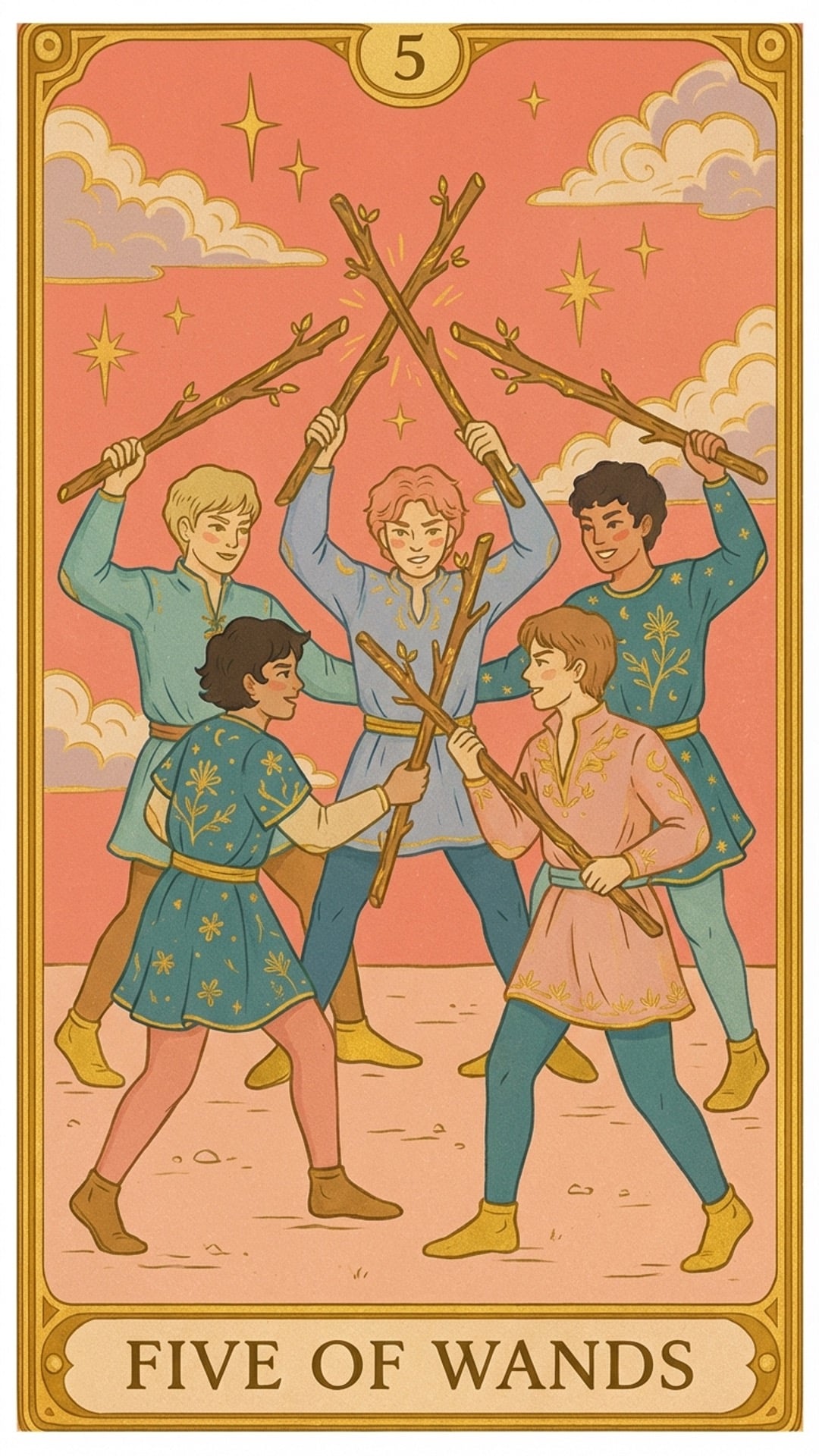
Overview
The Five of Wands captures a moment of creative chaos. Five figures brandish wands, their movements suggesting conflict, competition, or at least vigorous disagreement. Yet in many depictions, the scene is not quite a battle — it is more like a heated debate, a sporting contest, or a group of passionate people who cannot quite agree on the rules. The Five of Wands speaks to the friction that arises when multiple strong wills collide, each convinced of their own vision.
In the Wands journey, we have moved from the pure spark of the Ace through planning, expansion, and celebration. The Five introduces the first real obstacle: other people. Passion is contagious, but it is also competitive. When everyone has fire, everyone wants to lead. The Five of Wands is the card of the creative clash — the brainstorming session that gets loud, the team project where everyone has a different idea, the relationship where both partners have strong opinions.
This card does not necessarily indicate lasting harm. Often, the conflict in the Five is productive — it forces clarity, sharpens ideas, and reveals where compromise is needed. The key is to channel the energy toward resolution rather than escalation. The Five asks: can you fight for your vision without destroying the possibility of collaboration?
Card Symbolism
In the Rider-Waite-Smith tradition, the Five of Wands shows five young figures in a field, each holding a wand. They appear to be striking at each other, yet their movements are somewhat theatrical — more like a mock battle or a competitive game than a true fight. No one seems seriously injured; the energy is chaotic but not necessarily violent. The sky is clear, suggesting that the conflict is not cosmic but human — something that can be worked through.
The five wands create a tangle of crossed sticks, symbolizing the complexity of conflicting interests. Each figure represents a different perspective, a different agenda. They are not necessarily enemies; they may simply be competitors or collaborators who have not yet found their rhythm. The lack of clear hierarchy — no one is obviously winning — suggests that the outcome is still undetermined. Resolution is possible.
The open landscape implies that there is space to move, to breathe, to find a new configuration. The conflict is not trapped; it is in progress. The card invites you to step back, assess the dynamics, and find a way to channel the collective energy toward a shared goal.
Upright Meaning
When the Five of Wands appears upright, you are in a situation of conflict or competition. This may be literal — arguments with colleagues, family tension, rivalry — or it may be more subtle: creative differences, competing priorities, or the sense that you are constantly having to defend your position. The card suggests that multiple strong wills are at play, and harmony will require effort.
The Five upright often indicates that the conflict is not entirely negative. Healthy competition can drive innovation; disagreement can sharpen thinking. The challenge is to engage without destroying. Can you advocate for your vision while remaining open to others' ideas? Can you stand your ground without making enemies? The card invites you to find the balance between assertion and collaboration.
In practical terms, the Five of Wands can signify a competitive work environment, family disagreements, creative differences in a project, or the challenge of co-parenting or shared decision-making. The key is to recognize that conflict is a form of engagement — the opposite of conflict is often indifference. The fact that people care enough to disagree can be a starting point for deeper understanding.
Reversed Meaning
The Five of Wands reversed suggests that conflict is shifting — perhaps resolving, perhaps internalizing, or perhaps being avoided. You may be learning to pick your battles, to let go of the need to win every argument, or to find common ground with those who once seemed like opponents. The reversal can indicate a move from competition to collaboration.
Another interpretation is internal conflict. You may be at odds with yourself — torn between options, unable to align your actions with your values, or struggling with self-criticism. The external battles may have quieted, but the internal ones remain. The reversed Five invites you to make peace within yourself first. What are you fighting against? What would it mean to lay down your wand?
The reversal can also indicate avoidance. Perhaps you are walking away from necessary conflict because it feels too uncomfortable. The card does not always say "fight" — sometimes it says "engage." Avoiding conflict can leave issues unresolved and resentment simmering. The reversed Five asks you to find a way to address what needs addressing, even if it is uncomfortable.
Love & Relationships
In love, the Five of Wands suggests tension and power struggles. For couples, this may mean frequent arguments, competing needs, or the sense that you and your partner are on different teams. The card does not necessarily predict breakup — it describes a phase. Many strong relationships go through periods of conflict; what matters is how you navigate them. The Five invites honesty, compromise, and the willingness to hear your partner's perspective even when you disagree.
For singles, the Five can indicate dating competition — perhaps you are interested in someone who has other suitors, or you are navigating a situationship with unclear boundaries. It may also suggest that you attract or are attracted to people with strong personalities, which creates both spark and friction. The card encourages you to be clear about what you want and to communicate it directly rather than engaging in games.
Reversed in love, the Five may indicate that arguments are cooling down, that you are learning to fight fair, or that you are choosing to avoid unnecessary conflict. It can also suggest that you are internalizing relationship tension — perhaps sacrificing your needs to keep the peace. The card asks you to find a balance: engage when it matters, let go when it does not.
Career & Finances
The Five of Wands is a common card in career readings, especially in competitive or collaborative environments. Upright, it points to workplace competition — perhaps rivalry for a promotion, conflicting ideas in a team, or office politics that require careful navigation. The card suggests that success is possible, but it will require diplomacy, clear communication, and the ability to stand your ground without making enemies.
The Five can also indicate creative tension in a project. Different stakeholders may have different visions; your job may be to find the synthesis. This is not necessarily negative — the best ideas often emerge from the clash of perspectives. The key is to channel the energy toward innovation rather than obstruction.
Financially, the Five may suggest competition for resources, disputes over money, or the need to negotiate. It can indicate a situation where you must advocate for your worth — asking for a raise, bidding on a project, or defending your rates. The card says: be prepared to compete, but compete fairly.
Advice
The Five of Wands offers a nuanced piece of advice: engage with the conflict, but do not let it consume you. Conflict is often a sign that people care — that they have stakes in the outcome. The challenge is to channel that caring toward resolution rather than destruction. Ask yourself: what is each person really fighting for? Beneath the surface of disagreement, there may be shared values that can form the basis of compromise.
Choose your battles wisely. Not every disagreement deserves full engagement. Sometimes the wisest move is to step back, to let others have their say, and to conserve your energy for what truly matters. The Five does not say "win at all costs" — it says "understand the dynamics and act with intention."
Finally, remember that you can disagree without being disagreeable. Passion is a gift of the Wands suit; the Five reminds us that it can burn bridges or forge them, depending on how we wield it.
Yes or No
The Five of Wands leans toward No or Maybe. This card suggests conflict, obstacles, or the need to resolve disagreements before moving forward. For questions about partnerships, collaborations, or situations requiring harmony, the Five advises caution — there may be tension to work through first.
If the card appears reversed, the answer may shift toward a cautious yes. Conflict may be resolving, or you may be learning to navigate it more effectively. The opportunity might still be there; it may simply require patience and diplomacy to access it. For questions about whether to engage in conflict, the Five says: choose wisely. Not every battle is worth fighting.
Frequently Asked Questions About the Five of Wands
What does the Five of Wands mean in a tarot reading?
The Five of Wands represents conflict, competition, and the creative tension that arises when multiple passionate voices clash. The card typically depicts five figures brandishing wands in a chaotic, seemingly combative scene — yet the conflict is often more about ego and differing perspectives than true hostility. This card speaks to disagreements, rivalry, and the challenge of working with others when everyone wants to be heard. It reminds us that passion without coordination creates chaos, but that healthy competition can also fuel growth and innovation.
Is the Five of Wands a yes or no card?
The Five of Wands leans toward no or maybe when it appears in a yes-or-no reading. This card suggests conflict, obstacles, or the need to resolve disagreements before moving forward. For questions about partnerships, collaborations, or situations requiring harmony, the Five of Wands advises caution — there may be tension to work through first. In reversed position, the card can indicate that conflict is resolving or that you are learning to collaborate better, which may shift the answer toward a cautious yes.
What does the Five of Wands mean in love?
In love readings, the Five of Wands suggests tension, arguments, or power struggles within a relationship. You and your partner may have different visions, competing needs, or simply rub each other the wrong way during this phase. For singles, it can indicate dating competition, mixed signals, or the challenge of finding harmony with someone who has a strong personality. The card does not necessarily mean the relationship is doomed — it means that conflict is present and needs to be addressed with honesty and a willingness to compromise.
What does the Five of Wands reversed mean?
The Five of Wands reversed suggests that conflict is resolving, that you are learning to work through disagreements, or that you are choosing to avoid unnecessary battles. This reversal can indicate a shift from competition to collaboration — perhaps you have realized that fighting is not worth the cost. It may also point to internal conflict: you may be at odds with yourself, unable to choose between options or to align your actions with your values. The card invites you to find common ground, both with others and within yourself.
How does the Five of Wands relate to career?
In career readings, the Five of Wands points to workplace competition, office politics, or the challenge of collaborating with strong-willed colleagues. It may indicate rivalry for a promotion, conflicting ideas in a team, or a work environment where everyone is fighting for recognition. The card suggests that success is possible, but it will require diplomacy, clear communication, and the ability to stand your ground without escalating conflict. Reversed, it can indicate that competition is cooling down or that you are learning to navigate workplace dynamics more effectively.