
Nine of Swords Tarot Card
The card of anxiety, worry, and the fear that haunts the mind
Overview
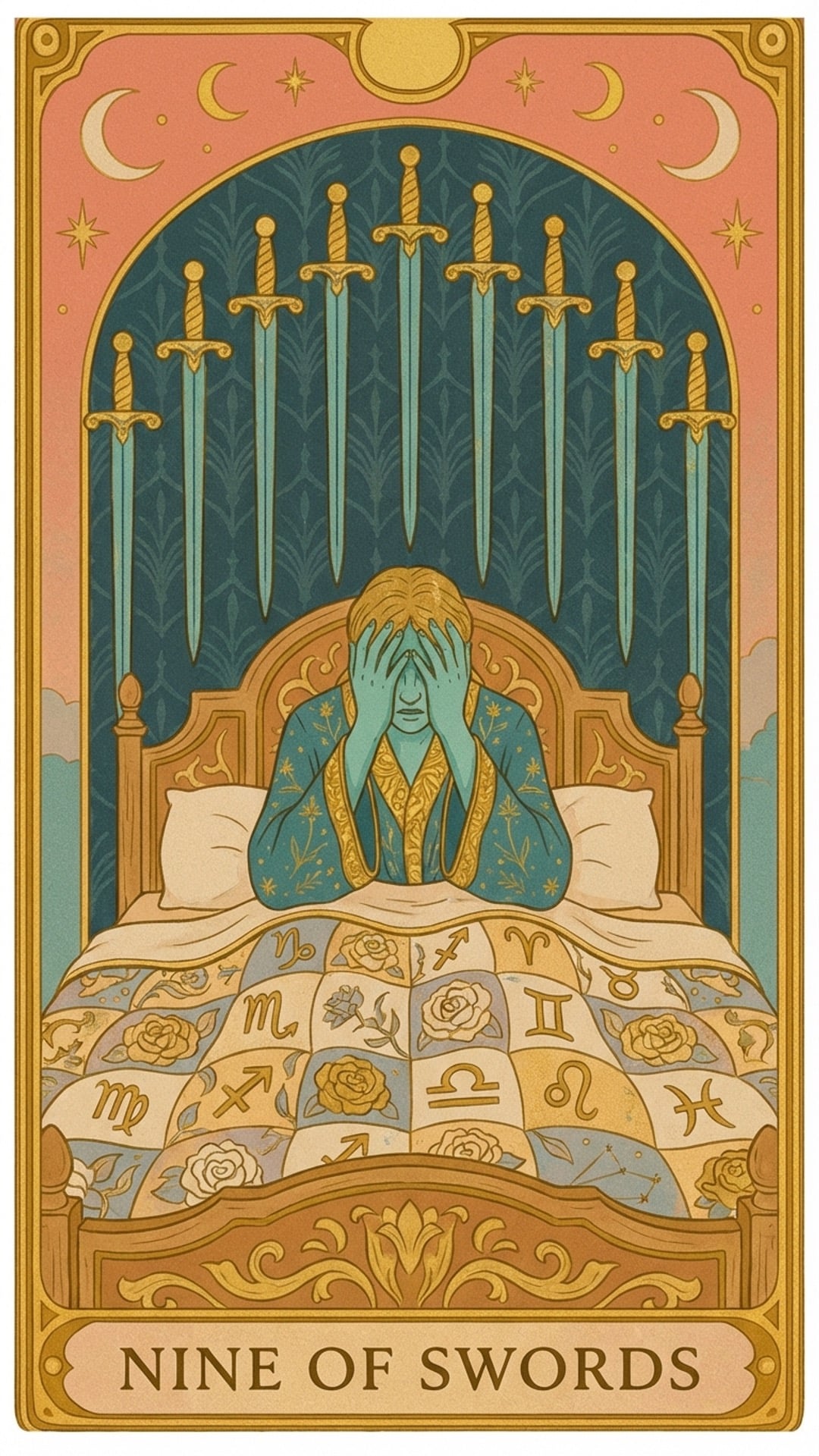
The Nine of Swords is the tarot's portrait of anxiety. A figure sits up in bed, head in hands, often in a posture of despair. Nine swords hang on the wall behind them — or float in the darkness — suggesting that the weapons are in the mind. We are surrounded by our own fearful thoughts, our worst-case scenarios, our midnight terrors.
When the Nine of Swords appears in your reading, you may be in the grip of worry. The card does not always mean that something bad will happen; often, it means that we fear something bad will happen. The distinction matters. Anxiety lives in the gap between the present moment and the imagined future — and it can make that future feel more real than the now.
The Nine of Swords speaks to the universal human experience of mental anguish. We have all lain awake at night, tormented by thoughts we cannot quiet. The card validates that experience — and reminds us that the night ends, that dawn comes, and that we are not alone in the dark.
Card Symbolism
The Nine of Swords typically shows a figure in bed — often in a dark room, often with a quilt or blanket that suggests both comfort and confinement. The figure's posture suggests despair: head in hands, perhaps weeping, perhaps frozen in fear. The nine swords are displayed on the wall behind, or arranged in a way that suggests they surround the figure. They are not being wielded; they are present, looming, like the thoughts that haunt us.
The number nine in tarot often relates to completion, culmination, and the edge of transition. In the Nine of Swords, this energy manifests as the culmination of worry — we have reached a peak of anxiety, and we cannot go much further in this direction. The only way is through, and then out.
The darkness in the card is significant. Anxiety thrives in the dark — both literal and metaphorical. When we cannot see clearly, our minds fill the void with fear. The card suggests that light — clarity, perspective, the dawn — will change the picture.
Upright Meaning
When the Nine of Swords appears upright, you may be experiencing significant anxiety. You may be worrying about health, finances, relationships, or the future in general. You may be lying awake at night, unable to quiet your mind. You may be anticipating disaster even when there is no immediate evidence for it.
The card often appears when we're in a period of stress — when circumstances are uncertain, when we've received bad news, or when we're waiting for an outcome that matters to us. Anxiety is a natural response to uncertainty. The Nine of Swords does not judge that response; it names it.
The card can also indicate guilt, shame, or the weight of past actions. Sometimes the swords are the judgments we level at ourselves — the things we've done or failed to do that haunt us. The Nine of Swords invites you to distinguish between productive self-reflection and destructive self-attack. One leads to growth; the other leads to paralysis.
Reversed Meaning
The Nine of Swords reversed suggests that you are emerging from a period of anxiety. The worst of the fear is passing. You're beginning to see that the situation may not be as dire as you imagined, or that you have more resources to cope than you believed.
This reversal can indicate that you've received reassurance — information that calms your fears, or the support of others that reminds you you're not alone. It may also indicate that you're actively working on managing anxiety — through therapy, medication, meditation, or lifestyle changes. The reversed Nine of Swords encourages you to continue that work.
In some cases, the reversal warns that you're suppressing anxiety rather than addressing it. Are you pushing down your fears instead of facing them? Are you using busyness, substances, or denial to avoid the discomfort? The card invites you to ensure that you're truly healing, not just numbing. Suppressed anxiety tends to return.
Love & Relationships
In love readings, the Nine of Swords often indicates anxiety about a relationship. You may be worrying about your partner's fidelity, about whether you're loved, about the relationship ending, or about being abandoned. The card can suggest sleepless nights, obsessive thoughts, or the tendency to imagine the worst.
For singles, the Nine of Swords may indicate that fear is blocking you from love. You may be afraid of rejection, of vulnerability, of repeating past pain. These fears can become self-fulfilling — we protect ourselves so thoroughly that we never allow connection. The card invites you to examine whether your fears are based on evidence or on imagination.
For those in relationships, the Nine of Swords can indicate a period of doubt, insecurity, or jealousy. It may suggest that one or both partners are struggling with trust. The card advises communication — sometimes our fears are based on misunderstanding, and a conversation can bring relief. If the anxiety is severe or persistent, professional support may help.
Career & Finances
The Nine of Swords brings the energy of anxiety to career readings. You may be worrying about job security, about a project that's not going well, or about conflict with a colleague or boss. The card can indicate imposter syndrome — the fear that you're not good enough, that you'll be found out, that you don't belong.
If you've been waiting for news — a promotion, a job offer, a contract — the Nine of Swords may simply reflect the anxiety of waiting. The card does not necessarily predict a negative outcome; it reflects your state of mind.
Financially, the Nine of Swords can indicate money anxiety — worry about debt, about making ends meet, or about the future. The card advises grounding yourself in facts: What is your actual situation? What can you control? Sometimes we catastrophize our financial picture; sometimes we need to make a plan. Both require clarity that anxiety can obscure.
Advice
The Nine of Swords advises you to tend to your mental state. Anxiety is not a character flaw; it is a human experience. But when it overwhelms, it can distort our perception and limit our choices. The first step is to recognize that you're in its grip.
Seek to distinguish between real threat and imagined threat. Is there actual evidence for your fear? What would someone who loved you say? Sometimes the act of naming our fears — writing them down, speaking them aloud — reduces their power. They become smaller when they're outside our heads.
Seek support. You don't have to carry anxiety alone. Talk to someone you trust. Consider professional help if the anxiety is severe or persistent. There is no shame in needing support.
Finally, remember that the Nine of Swords is not permanent. The card depicts a moment in the night — and the night ends. Dawn comes. This too shall pass.
Yes or No
The Nine of Swords is generally a No — but often because anxiety is clouding the situation. You may be too overwhelmed to move forward with clarity, or you may be seeing obstacles that aren't there. The card advises addressing your anxiety before making decisions.
In reversed position, the answer may shift toward maybe or yes. You're emerging from worry; the worst of the fear is passing. Ensure that your answer comes from a place of calm, not from a place of fear. When in doubt, wait for clarity.
Frequently Asked Questions About the Nine of Swords
What does the Nine of Swords tarot card mean in a reading?
The Nine of Swords represents anxiety, worry, and the fear that lives in the mind. When this card appears, you may be experiencing mental anguish — the kind that keeps you up at night, that spins worst-case scenarios, or that makes you feel as though disaster is imminent. The card typically depicts a figure sitting up in bed, head in hands, with nine swords on the wall behind them. The imagery suggests that the swords are in the mind — we are surrounded by our own fearful thoughts. The Nine of Swords does not always indicate that something bad will happen; often, it indicates that we fear something bad will happen. The card invites you to distinguish between real threat and imagined threat, and to seek support when anxiety overwhelms. It also carries a message of hope: the night is darkest before the dawn, and this too shall pass.
Is the Nine of Swords a yes or no card?
The Nine of Swords is generally a no when it appears in yes-or-no readings — but often because anxiety is clouding the situation, not because the actual answer is no. This card suggests that fear may be influencing your perception. You may be seeing obstacles that aren't there, or you may be too overwhelmed to move forward with clarity. The card advises addressing your anxiety before making decisions. In reversed position, the Nine of Swords can indicate that you're emerging from a period of worry — the worst of the fear is passing, and clarity is returning. In that case, the answer may shift toward maybe or yes as you gain perspective. The key is to ensure that your answer comes from a place of calm, not from a place of fear.
What does the Nine of Swords mean in love?
In love readings, the Nine of Swords often indicates anxiety about a relationship — or anxiety that is affecting your ability to connect. You may be worrying about your partner's fidelity, about whether you're loved, or about the relationship ending. For singles, the card can suggest that fear is blocking you from love — perhaps you're afraid of rejection, of vulnerability, or of repeating past pain. The Nine of Swords invites you to examine whether your fears are based on evidence or on imagination. Are you responding to real signals, or to the stories your mind is telling? For those in relationships, the card can indicate a period of doubt, insecurity, or sleepless nights over the relationship. Communication and, if needed, professional support can help. The card reminds you that anxiety often exaggerates; the truth may be less dire than your fears suggest.
What does the Nine of Swords reversed mean?
The Nine of Swords reversed suggests that you are emerging from a period of anxiety and worry. The worst of the fear is passing; you're beginning to see that the situation may not be as dire as you imagined. This reversal can indicate that you've received reassurance, that circumstances have clarified, or that you've simply exhausted the anxiety and are ready to move forward. It may also suggest that you're actively working on managing anxiety — through therapy, meditation, or lifestyle changes. The reversed Nine of Swords encourages you to continue that work and to trust that relief is possible. In some cases, the reversal warns that you're suppressing anxiety rather than addressing it. Are you pushing down your fears instead of facing them? The card invites you to ensure that you're truly healing, not just numbing.
How can you cope when the Nine of Swords appears?
The Nine of Swords invites several coping strategies. First, distinguish between real and imagined threat. Is there actual evidence for your fear, or is your mind spinning? Second, limit exposure to triggers — if the news, social media, or certain conversations amplify your anxiety, create boundaries. Third, ground yourself in the present. Anxiety often lives in the future; practices like mindfulness, breathing exercises, or focusing on your senses can bring you back to the now. Fourth, seek support. Anxiety can be isolating, but you don't have to carry it alone. Talk to a trusted friend, consider therapy, or reach out to a support group. Fifth, remember that the Nine of Swords is not permanent. The card depicts a moment in the night — and the night ends. This too shall pass. If anxiety is severe or persistent, professional help is not a sign of weakness; it is a sign of self-care.