
Seven of Swords Tarot Card
The card of strategy, cunning, and the complex nature of self-protection
Overview
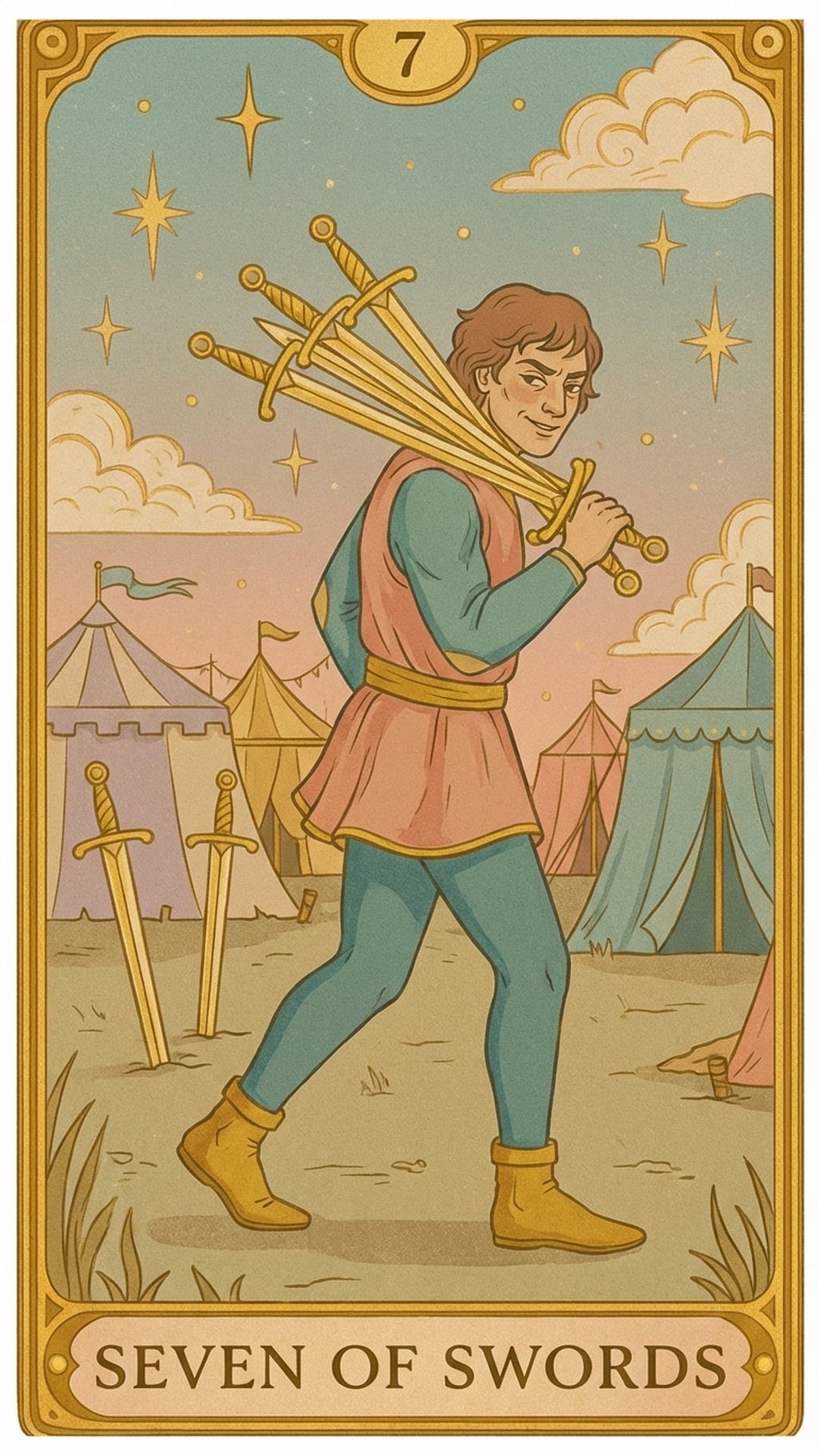
The Seven of Swords is the tarot's portrait of strategy and its shadow. A figure — often a thief or a cunning strategist — is depicted taking swords from a camp, leaving some behind, perhaps glancing over their shoulder. The image is ambiguous: Is this person a villain stealing what doesn't belong to them? Or a survivor taking what they need to protect themselves? The card holds that ambiguity deliberately.
When the Seven of Swords appears in your reading, you are being invited to examine the role of strategy, secrecy, and self-protection in your life. Are you being wisely discreet, or are you crossing into deception? Are you protecting yourself from those who would harm you, or are you the one causing harm? The card does not always condemn cunning — sometimes strategy is necessary. But it asks you to look clearly at your motives and methods.
The Seven of Swords speaks to the complexity of the human mind — our capacity for cleverness, for seeing angles others miss, and for the shadow capacity to use that cleverness in ways that hurt others or ourselves.
Card Symbolism
The Seven of Swords typically shows a figure in the act of taking — swords from a camp, resources from a situation, or information that was not freely given. The figure may be sneaking, running, or glancing back with a mix of triumph and unease. The body language suggests that this is a covert operation — something is being done that would not withstand full scrutiny.
The seven swords can represent the tools of the mind — strategy, information, resources. The fact that some are taken and some are left suggests selectivity: we choose what we need, what we can carry, what serves our purpose. The imagery raises the question: Who do these swords belong to? And what gives us the right to take them?
The camp or background often suggests a collective — an army, a community, a relationship. The figure is taking from that collective. The symbolism invites reflection on the balance between individual need and collective good, between self-protection and betrayal.
Upright Meaning
When the Seven of Swords appears upright, you may be in a situation that requires strategy. You may need to protect your interests, to be discreet about your plans, or to navigate a complex dynamic where not everyone has your best interests at heart. In this light, the card supports careful planning and the wise protection of your resources, your privacy, or your position.
Alternatively, the Seven of Swords can indicate that you are the one using cunning in ways that may not be entirely ethical. Are you hiding something? Are you manipulating a situation? Are you taking what isn't yours — materially, emotionally, or in terms of credit? The card invites honest self-examination.
The Seven of Swords can also indicate that someone else is being deceptive. You may need to be wary — to look beneath the surface, to verify what you're being told, and to protect yourself from those who would take advantage. Trust, but verify.
Reversed Meaning
The Seven of Swords reversed can mean that deception is being revealed. Secrets are coming to light; what was hidden is now visible. If you've been the one in the dark, this can be a moment of clarity — and possibly pain. If you've been the one hiding, this can be a moment of reckoning.
The reversal can also indicate that you're choosing honesty over cunning. You're no longer willing to use strategy that compromises your integrity. You're laying down the stolen swords and walking in the light. This is often a positive development — the release of the burden of secrecy.
In some cases, the reversed Seven of Swords warns that you're being too trusting. Perhaps you've let your guard down when caution is still warranted. The card invites you to find the balance: not everyone is out to get you, but not everyone has your best interests at heart either.
Love & Relationships
In love readings, the Seven of Swords often indicates secrecy or the need for boundaries. You or your partner may be hiding something — not necessarily infidelity, but perhaps feelings, past history, or true intentions. The card can suggest that someone is not being fully transparent.
For singles, the Seven of Swords may indicate that you're protecting yourself by not fully opening up. This can be wise — we don't owe everyone our full story immediately. But it can also prevent genuine connection. The card invites you to examine: Are you being strategically guarded, or are you hiding from vulnerability? There's a difference.
For those in relationships, the Seven of Swords can signal the need for honest conversation about what has been unspoken. It may also indicate that one partner has been deceptive — and that the truth may soon be revealed. The card advises both transparency and discernment: be honest, and also be aware of whether you're receiving honesty in return.
Career & Finances
The Seven of Swords brings the energy of strategy to career readings. You may need to be discreet about your plans — perhaps you're job-searching while employed, or you're developing a project that isn't ready to be shared. The card supports strategic thinking and the wise protection of your professional interests.
The card can also indicate office politics — the need to navigate carefully, to avoid sharing too much with the wrong people, or to protect your ideas and your position. In some cases, the Seven of Swords warns of deception in the workplace: someone may not be acting in good faith. Protect yourself, document what matters, and avoid becoming collateral damage in others' games.
Financially, the Seven of Swords advises caution. Verify before you invest. Read the fine print. Be wary of deals that seem too good to be true. The card can also suggest that you need to protect your financial information or your assets from those who might take advantage.
Advice
The Seven of Swords advises you to examine your relationship with strategy and secrecy. Are you protecting yourself appropriately, or are you crossing into deception? The line can be fine, but it exists. Protecting your privacy is not the same as lying. Strategic discretion is not the same as manipulation.
If you've been the one using cunning, the card invites you to consider the cost. What happens when the truth comes out? What does it do to your sense of self to operate in the shadows? Sometimes the short-term gain of strategy is outweighed by the long-term cost to trust and integrity.
If you've been the one deceived, the card advises awareness. Not everyone is trustworthy. Verify, protect yourself, and don't feel guilty for healthy skepticism. At the same time, don't let the Seven of Swords turn you into someone who trusts no one. The goal is discernment, not paranoia.
Yes or No
The Seven of Swords is generally a Maybe. This card suggests that the situation is complex — there may be hidden factors, strategic considerations, or the need for caution.
If you're asking whether to proceed, the Seven of Swords advises you to look beneath the surface. Are you seeing the full picture? Are others being fully honest with you? The card can indicate that a yes might be possible through strategy, but it warns against achieving goals through deception. In reversed position, the answer may shift — deception may be revealed, or you may be choosing honesty. Proceed with clarity.
Frequently Asked Questions About the Seven of Swords
What does the Seven of Swords tarot card mean in a reading?
The Seven of Swords represents strategy, cunning, and the complex dynamics of self-protection versus deception. When this card appears, you may be in a situation that requires careful planning, discretion, or the protection of your interests. The card typically depicts a figure stealing swords from a camp — a thief or strategist taking what they need and leaving. This imagery can indicate several things: the need to protect yourself by not revealing everything, the use of strategy to achieve a goal, or the shadow side — deception, betrayal, or acting in ways that lack integrity. The Seven of Swords invites you to examine your motives. Are you protecting yourself or harming others? Are you being strategic or dishonest? The card holds a mirror to the fine line between self-preservation and manipulation.
Is the Seven of Swords a yes or no card?
The Seven of Swords is generally a maybe when it appears in yes-or-no readings. This card suggests that the situation is complex — there may be hidden factors, strategic considerations, or the need for caution. If you're asking whether to proceed with something, the Seven of Swords advises you to look beneath the surface. Are you seeing the full picture? Are others being fully honest with you? The card can indicate that a yes might be possible through strategy, but it warns against achieving goals through deception. In reversed position, the Seven of Swords may suggest that deception is being revealed, that you're choosing honesty over cunning, or that a strategic approach is no longer needed. The answer may shift based on whether you're the one being strategic or the one who needs to be wary.
What does the Seven of Swords mean in love?
In love readings, the Seven of Swords often indicates secrecy, deception, or the need for boundaries. You or your partner may be hiding something — not necessarily infidelity, but perhaps feelings, past history, or true intentions. The card can suggest that someone is not being fully transparent, and that trust may need to be examined. For singles, the Seven of Swords may indicate that you're protecting yourself by not fully opening up — which can be wise, but can also prevent genuine connection. Are you being strategically guarded, or are you hiding from vulnerability? For those in relationships, the card can signal the need for honest conversation about what has been unspoken. Alternatively, it may indicate that one partner has been deceptive — the swords have been taken, and the truth may soon be revealed.
What does the Seven of Swords reversed mean?
The Seven of Swords reversed can mean several things. On one hand, it may indicate that deception is being revealed — secrets are coming to light, and what was hidden is now visible. This can be a relief if you've been the one deceived; it can be a reckoning if you've been the one hiding. On the other hand, the reversal can suggest that you're choosing honesty over cunning. You're no longer willing to use strategy that compromises your integrity. You're laying down the stolen swords and walking in the light. In some cases, the reversed Seven of Swords warns that you're being too trusting — perhaps you've let your guard down when caution is still warranted. The card invites you to find the balance between healthy skepticism and paranoid suspicion.
When is the Seven of Swords positive versus negative?
The Seven of Swords is one of the most context-dependent cards in the tarot. In a positive light, it can indicate strategic thinking, the wise protection of your interests, and the ability to navigate complex situations with discernment. It can suggest that you're not revealing everything — and that discretion is appropriate. In a negative light, it can indicate deception, betrayal, theft, or the use of cunning to harm others. The key is motive and method. Are you protecting yourself in a situation where others would take advantage? That's the positive Seven. Are you manipulating, lying, or taking what isn't yours? That's the negative Seven. The card invites you to be honest with yourself about which side of the line you're on — and to remember that the swords can cut both ways.