
Ten of Wands
The weight of achievement — burdens, responsibility, and the cost of carrying too much
Overview
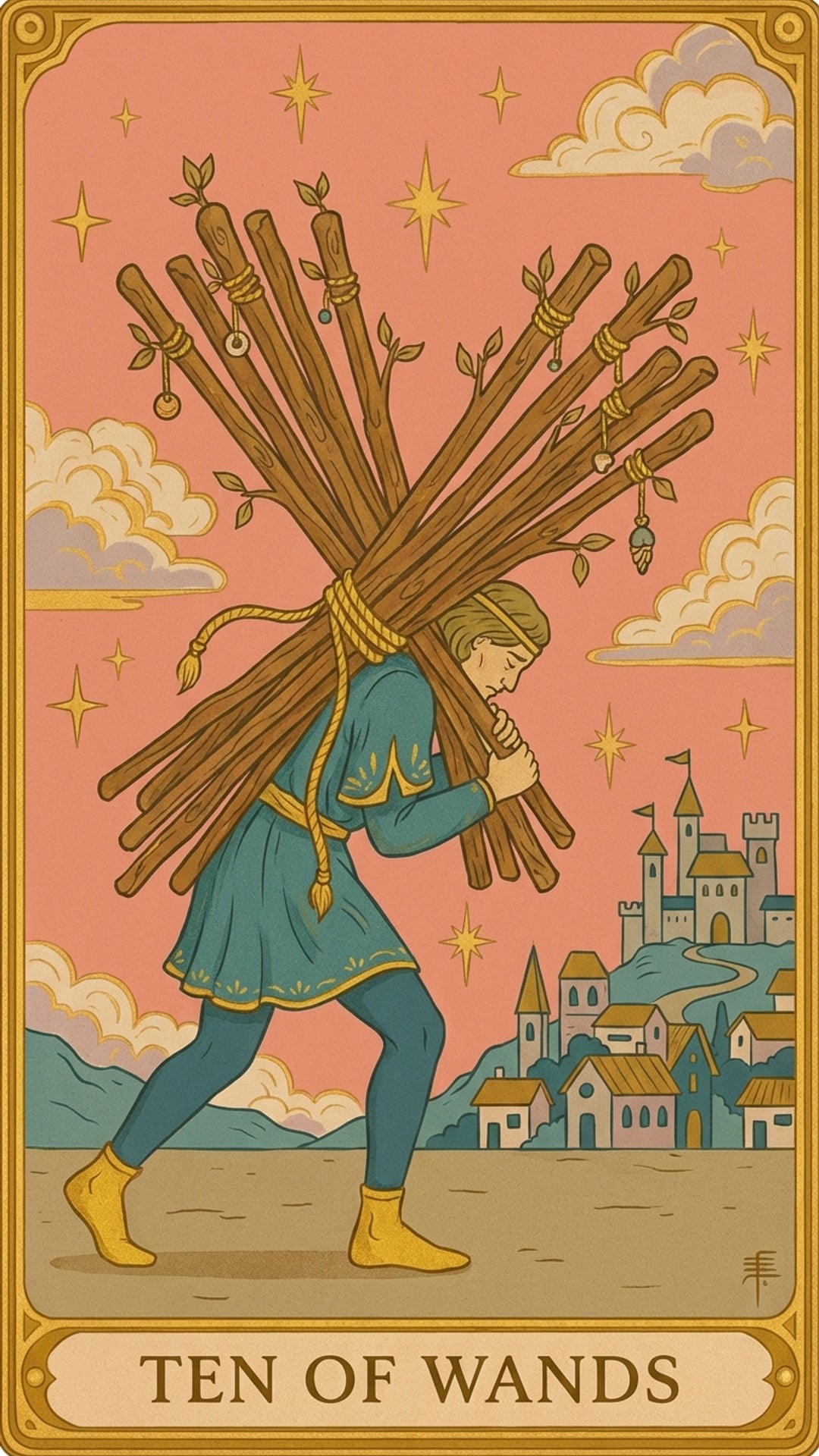
The Ten of Wands captures the moment when achievement becomes burden. The figure on the card struggles under the weight of ten wands, bent forward, often unable to see the path ahead. They have gathered everything — every project, every responsibility, every expectation — and now they carry it all. The cost of success is visible in their posture: they have achieved much, but the weight is crushing.
In the Wands journey, we have moved through the full arc of passion and ambition — from the spark of the Ace to the accumulated weight of the Ten. The numbered Wands cards tell a story: inspiration, planning, expansion, celebration, conflict, victory, defense, momentum, and resilience. The Ten is the culmination: you have built something significant, but you have also accumulated the weight of it. The question is no longer "can you achieve?" but "can you carry what you have achieved — and do you need to carry all of it?"
The Ten of Wands does not diminish your accomplishments. It acknowledges that success has a cost. Some of the weight you carry may be necessary; some of it may be habit, obligation, or the inability to say no. The card invites you to distinguish between what you must carry and what you can release. Relief is possible — but it requires conscious choice.
Card Symbolism
In the Rider-Waite-Smith tradition, the Ten of Wands shows a figure bent under the weight of ten large wands, which they clutch in their arms. They are often walking toward a distant town or structure — the destination is in sight, but the journey is arduous. The figure's posture is strained; they cannot see where they are going because the wands obscure their view. The sky may be clear, but their world has narrowed to the weight they carry.
The ten wands represent the completion of the suit — the full accumulation of creative and passionate energy. In the Ace, there was one wand, a gift. In the Ten, there are ten, a burden. The progression suggests that what began as inspiration has become obligation. The figure has taken on more than they can comfortably hold. The question is: did they choose this, or did it accumulate gradually? Often it is both.
The distant town suggests that the goal is in sight — they are almost there. But the Ten asks: at what cost? Will they arrive too exhausted to enjoy what they have built? The card invites reflection on the relationship between achievement and wellbeing.
Upright Meaning
When the Ten of Wands appears upright, you are carrying a heavy load. This may be literal — too many projects, too many responsibilities — or it may be emotional or psychological. You may feel overwhelmed, burned out, or unable to see clearly because the weight of your obligations obscures your view. The card acknowledges your strength; you have carried this far. But it also asks: must you carry it all?
The Ten upright often indicates that you have taken on more than you need to. Some responsibilities may be yours by choice; others may have been assumed out of obligation, guilt, or the inability to say no. The card invites you to audit your load. What is essential? What could be delegated, shared, or released? Relief is possible — but it requires conscious action.
In practical terms, the Ten can signify burnout, the need to delegate, or a period when you must prioritize ruthlessly. It may also indicate that success has come with a cost — perhaps your health, your relationships, or your peace of mind has been sacrificed to achievement. The card says: you have done enough. It is time to consider what you can put down.
Reversed Meaning
The Ten of Wands reversed suggests that you are beginning to release your burdens — or that you need to. This reversal can indicate the conscious choice to put down what no longer serves you. You may be delegating, saying no, or walking away from responsibilities that were never truly yours. The relief is real, and it is welcome.
Another interpretation is that you are at risk of dropping everything suddenly. The reversal can indicate a collapse — burnout that forces you to stop, or a dramatic release of responsibilities that creates chaos. The card invites you to let go with intention rather than from crisis. What can you release gradually? What support do you need to make the transition sustainable?
The reversal may also point to the refusal to take on responsibility — perhaps you have swung from over-carrying to under-engaging. The Ten reversed asks you to find balance: carry what is yours, release what is not. Do not confuse healthy boundaries with abandonment of duty.
Love & Relationships
In love, the Ten of Wands suggests that a relationship may feel burdensome. Perhaps one partner carries most of the emotional or practical load — managing the household, initiating difficult conversations, or holding the weight of the partnership alone. The card can indicate that the relationship has accumulated responsibilities — children, finances, family obligations — that weigh on both people. The question is whether the load can be shared more fairly.
For singles, the Ten may suggest that you are carrying baggage from past relationships — unresolved hurt, fear, or the belief that you must be perfect before you can love again. It can also indicate that you feel too overwhelmed by life to open yourself to connection. The card encourages you to identify what you can release. Love requires space; when you are buried under wands, there is no room for it to enter.
Reversed in love, the Ten can point to the beginning of relief — perhaps you are setting boundaries, sharing the load more fairly, or releasing expectations that have weighed on the relationship. It may also indicate that you are walking away from a relationship that has become a burden. The card invites you to choose what you carry and what you release.
Career & Finances
The Ten of Wands is a common card in career readings when overwhelm is present. Upright, it points to too many projects, too much responsibility, or the sense that you are carrying the weight of the team or the organization. You may have achieved success, but the cost is visible: exhaustion, stress, or the inability to enjoy what you have built. The card suggests that the way forward requires lightening the load.
Financially, the Ten may indicate that financial success has come with burdens — perhaps debt, obligations, or the pressure to maintain a certain lifestyle. It can suggest that you are working too hard for the return you are getting, or that money has become a source of stress rather than freedom. The card invites you to reassess: what financial obligations are truly necessary? What could be restructured or released?
Reversed in career, the Ten can indicate that you are finally setting boundaries — saying no to new projects, delegating, or releasing responsibilities that were never truly yours. It may suggest a period of recovery after burnout, or the conscious choice to prioritize wellbeing over achievement. The relief is real; the card encourages you to embrace it.
Advice
The Ten of Wands offers a clear piece of advice: put some down. You do not have to carry everything. Some of what you hold may be essential; much of it may be habit, obligation, or the mistaken belief that you are the only one who can do it. Audit your load. What can be delegated? What can be released? What can be shared? Relief is not a luxury; it is a necessity for sustainable achievement.
If you are not sure what to put down, start with what obscures your view. The figure on the card cannot see where they are going because the wands block their sight. What responsibilities are preventing you from seeing clearly? What could you release that would restore your perspective? Sometimes the first wand to put down is the one that blocks your vision.
Finally, remember that asking for help is not weakness. The Ten of Wands often appears when we have taken on too much alone. Who can share the load? Who can you trust to carry some of the wands? You have proven your strength. Now prove your wisdom by knowing when to let go.
Yes or No
The Ten of Wands leans toward No when the question involves taking on more — more responsibility, more projects, more commitments. It suggests that you are already at capacity and that adding more could lead to burnout. For questions about whether you should say yes to a new opportunity, the Ten may advise caution: consider what you would need to release to make room.
For questions about whether to continue carrying a burden, the Ten may say: it is time to put some down. The answer is not necessarily "quit" — it is "lighten the load." If the card appears reversed, the answer may shift toward a cautious yes, as relief becomes possible. You may be in the process of releasing what weighs you down, which creates space for new possibilities.
Frequently Asked Questions About the Ten of Wands
What does the Ten of Wands mean in a tarot reading?
The Ten of Wands represents burdens, responsibility, and the weight of carrying too much. The figure on the card struggles under the weight of ten wands, bent forward, often unable to see the path ahead. This card speaks to overwhelm — the sense that you have taken on more than you can comfortably carry, that your responsibilities have accumulated beyond your capacity, or that success has come with a cost. It is the card of the overburdened, the one who has achieved much but now carries the weight of it all. It invites you to consider what you can release.
Is the Ten of Wands a yes or no card?
The Ten of Wands leans toward no when the question involves taking on more — more responsibility, more projects, more commitments. It suggests that you are already at capacity and that adding more could lead to burnout. For questions about whether to continue carrying a burden, the Ten may say: it is time to put some down. In reversed position, the card can indicate that you are beginning to release what weighs you down — in which case the answer may shift toward a cautious yes, as relief becomes possible.
What does the Ten of Wands mean in love?
In love readings, the Ten of Wands suggests that a relationship may feel burdensome — perhaps one partner carries most of the emotional or practical load, or the relationship has accumulated responsibilities that weigh on both people. For singles, it can indicate that you are carrying baggage from past relationships, or that you feel too overwhelmed by life to open yourself to love. The card encourages you to identify what can be shared, delegated, or released so that love has room to breathe.
What does the Ten of Wands reversed mean?
The Ten of Wands reversed suggests that you are beginning to release your burdens — or that you need to. This reversal can indicate the conscious choice to put down what no longer serves you: responsibilities you assumed out of obligation, projects that have run their course, or beliefs that have become heavy. It may also point to the risk of dropping everything suddenly — releasing burdens without care can create chaos. The card invites you to let go with intention, to delegate, and to prioritize what truly matters.
How does the Ten of Wands relate to career?
In career readings, the Ten of Wands points to overwhelm — too many projects, too much responsibility, or the sense that you are carrying the weight of the team or the organization. It may indicate burnout, the need to delegate, or the recognition that success has come with a cost. The card suggests that you have achieved much, but that the way forward requires lightening the load. Reversed, it can indicate that you are finally setting boundaries, saying no, or releasing responsibilities that were never truly yours to carry.