
The Hermit Tarot Card
The card of inner wisdom, solitude, and the search for truth
Overview
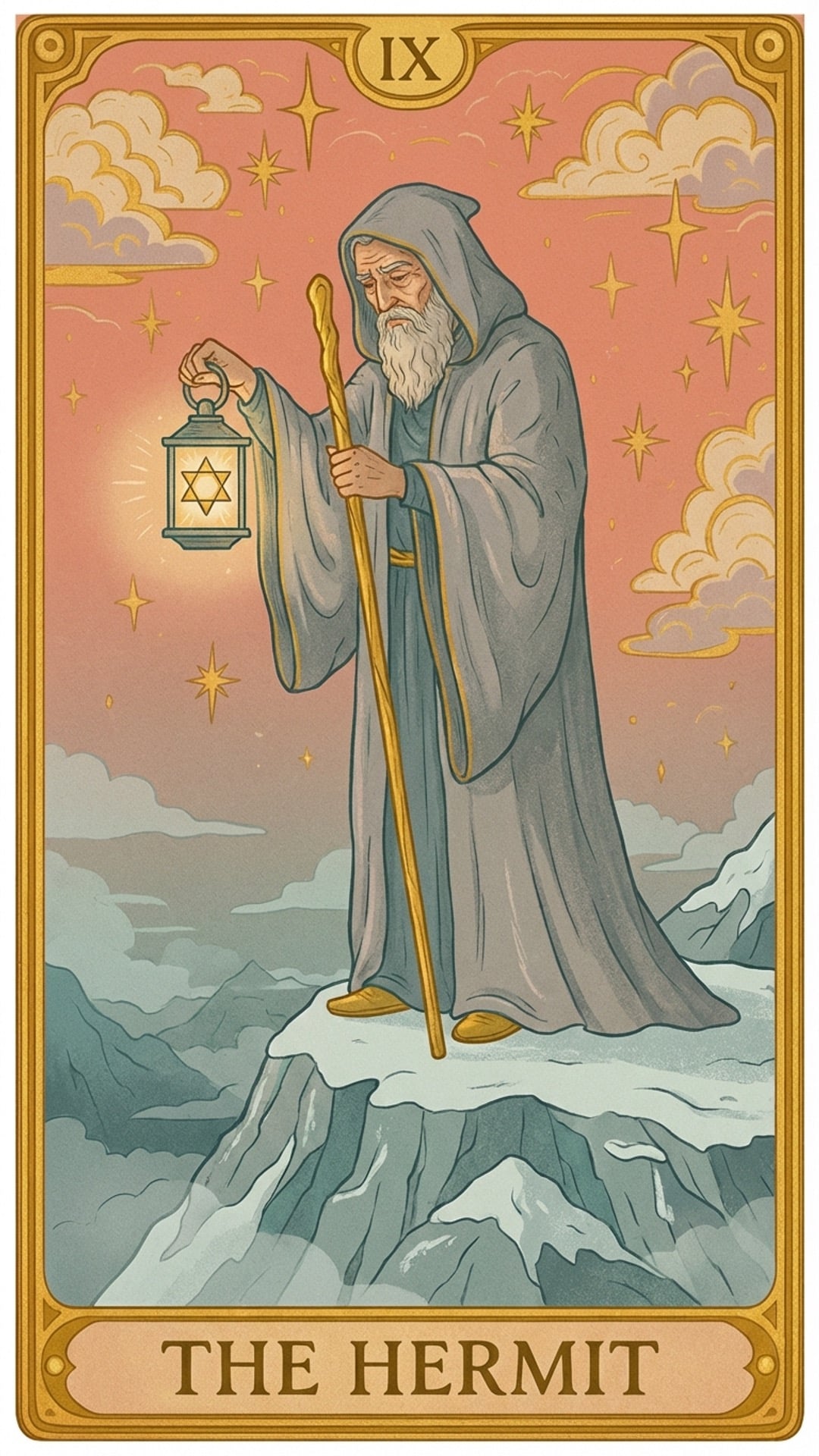
An elderly figure stands alone on a mountain peak, a lantern in one hand and a staff in the other, the vast night sky stretching behind him. As card number 9 in the Major Arcana, The Hermit tarot card embodies inner wisdom, solitude, and the sacred search for truth. He is the archetype of the wise elder who has withdrawn from the distractions of the world to seek answers that can only be found in silence — and who, having found them, carries a light to guide others when they are ready to see.
When The Hermit appears in your reading, the universe is inviting you to slow down and turn inward. This may mean taking time alone, reducing social commitments, or creating space for reflection amid the busyness of daily life. The Hermit does not rush. He knows that the most important answers — about who you are, what you value, and where you're going — emerge not from external input but from the quiet dialogue between you and your deepest self. His presence suggests that now is a time for introspection, not action.
The Hermit also represents the teacher who has walked the path before you. He stands on the mountain — the heights of experience — and holds his lamp aloft. The light he carries is not for himself alone; it is for those who will follow. When The Hermit appears, you may be called not only to seek wisdom but eventually to share it with others who are still finding their way.
Card Symbolism
The Hermit's imagery is spare and powerful. He stands alone on a snow-covered peak, suggesting both the heights of spiritual attainment and the cold clarity that comes with distance from the world's noise. His gray robe blends with the landscape — he has become part of the natural world, undistracted by the trappings of society. The staff in his hand provides stability on the steep path; the journey inward requires support.
The lantern he holds contains a six-pointed star — the Seal of Solomon, a symbol of the integration of opposing forces and the light of divine wisdom. The Hermit does not carry a torch that blazes; his is a contained, focused light. Wisdom, the card suggests, is not about illuminating everything at once but about seeing clearly what is directly in front of you, one step at a time.
The mountain itself represents the arduous nature of the inner journey. The path to self-knowledge is not easy; it requires discipline, patience, and the willingness to leave behind what is familiar. But the view from the top — the perspective gained — makes the climb worthwhile.
Upright Meaning
When The Hermit appears upright, you are being called to prioritize inner work over outer activity. This may mean taking a break from social engagements, spending more time in meditation or journaling, or simply creating daily moments of silence. The Hermit upright suggests that the answers you seek will not come from more information, more advice, or more distraction — they will come when you create space for them to emerge.
This card often appears during periods of transition or uncertainty. When the external world offers no clear direction, The Hermit says: look within. Your inner wisdom has something to tell you. The challenge is to create the conditions in which you can hear it. That might mean a literal retreat — a weekend alone, a meditation retreat — or it might mean carving out thirty minutes each day for reflection. The form matters less than the intention.
The Hermit upright can also indicate the presence of a mentor or guide — someone older, wiser, or further along the path who can offer perspective. Or it may suggest that you are being called to become that guide for others. The Hermit's journey is never purely selfish; the wisdom he gains is meant to be shared when the time is right.
Reversed Meaning
The Hermit reversed suggests an imbalance in the relationship between solitude and connection. You may be isolating yourself excessively — withdrawing from friends, family, or community when engagement would serve you better. Loneliness and the Hermit's chosen solitude are different; one is nourishing, the other depleting. The reversed card asks: are you withdrawing to seek wisdom, or to avoid the challenges of connection?
Alternatively, The Hermit reversed may point to the opposite problem: resistance to solitude. You might be filling every moment with activity, people, or noise because being alone feels uncomfortable. The card suggests that the introspection you've been avoiding may be exactly what you need. Some answers can only be found in silence. The Hermit reversed says: make time for yourself. The world will still be there when you return.
In some cases, this reversal indicates overthinking or analysis paralysis. You may have withdrawn into your head, turning things over and over without ever reaching clarity or taking action. The Hermit's wisdom is meant to inform action, not replace it. If you've been stuck in contemplation for too long, the reversal may be a nudge to reengage with the world — to test your insights in practice, to seek the perspective of others, or simply to move.
Love & Relationships
In love readings, The Hermit brings a nuanced message. Upright, it can indicate a need for space within a relationship — time alone to reflect, to reconnect with yourself, or to clarify what you truly want. This isn't necessarily negative; healthy partnerships allow for individuality. The Hermit in love says: it's okay to need solitude. A partner who respects that need is a partner worth keeping.
For singles, The Hermit often suggests that this is a time to focus on yourself rather than actively seeking a partner. The wisdom you gain in solitude will make you a better partner when the right person appears. The card can also indicate meeting someone through a spiritual or contemplative context — a meditation group, a retreat, or a shared interest in inner growth. The Hermit's love tends to be deep rather than flashy, built on mutual respect for each other's need for space and growth.
For those in relationships, The Hermit may point to a phase where one or both partners need more independence. This could mean separate hobbies, time with friends, or simply the freedom to have an inner life that isn't fully shared. The Hermit reminds us that we are whole people before we are partners; nurturing that wholeness strengthens the relationship.
Reversed in love, The Hermit may indicate excessive withdrawal, emotional unavailability, or a partner who is distant when connection is needed. It can also point to the need to come out of isolation — to reach out, to be vulnerable, to let someone in.
Career & Finances
In career readings, The Hermit suggests a period of reflection rather than aggressive action. Upright, it may indicate that you need to step back from the daily grind to gain perspective on your professional direction. Perhaps you've been on autopilot, and it's time to ask: does this work still serve me? What do I want the next chapter of my career to look like? The Hermit's wisdom comes through pause, not push.
This card can also point to work that involves research, analysis, or solitary focus. The Hermit favors roles that allow for deep concentration — writing, coding, scientific research, or any endeavor that benefits from uninterrupted thought. If you're in a highly social or chaotic work environment, The Hermit may be suggesting that you need to create more boundaries to protect your focus.
Financially, The Hermit advises careful consideration before major decisions. This is not a time for impulsive investments or rash spending. Take time to research, to reflect on your true needs versus wants, and to align your financial choices with your deeper values. The Hermit's approach to money is deliberate and considered.
Reversed in career, The Hermit may indicate isolation that's harming your professional growth — perhaps you need to network more, seek mentorship, or collaborate. Or it could point to overthinking that's preventing you from taking necessary action. Find the balance between reflection and engagement.
Advice
The Hermit's advice is to make space for silence. In a world that prizes constant connection and productivity, the Hermit reminds us that some of our most important work happens in solitude. Create time — daily, weekly, or in longer retreats — to be alone with your thoughts. Turn off the noise. Listen to what emerges when you stop filling the space.
Trust the process. The Hermit's journey does not follow a linear timeline. Insights may come slowly, in fragments, or in sudden flashes after long periods of apparent stagnation. The key is to keep showing up — to the meditation cushion, the journal, the quiet walk — without demanding immediate results. Wisdom reveals itself when it's ready.
Finally, remember that the Hermit's light is meant to be shared. However much you need solitude now, the purpose of inner work is not to stay forever on the mountain. At some point, you will descend — and the light you carry will guide others who are still climbing. Your wisdom, when it comes, is a gift. Offer it when the time is right.
Yes or No
The Hermit leans toward Maybe or Wait. This card suggests that the answer is not yet clear — and that you need to seek it through introspection rather than external action. If you're asking whether to make a decision, the Hermit advises patience. Take time alone. Reflect. The clarity you need will emerge when you create space for it.
For questions about whether to pursue spiritual growth, take a retreat, or prioritize inner work, The Hermit says yes. For questions requiring immediate action, his energy suggests that more reflection is needed first. Trust that the pause is purposeful. The Hermit does not rush — and neither should you, when the question at hand requires the wisdom that only time and solitude can provide.
Frequently Asked Questions About The Hermit
What does The Hermit tarot card mean in a reading?
The Hermit represents inner wisdom, solitude, and the search for truth. When this card appears, it signals a time for introspection, withdrawal from the noise of the world, and the pursuit of answers that can only be found within. The Hermit is card number 9 in the Major Arcana — the archetype of the wise elder who has retreated from society to seek deeper understanding. It invites you to take time alone, to listen to your inner voice, and to trust that the answers you seek will emerge when you create space for silence. The Hermit reminds us that wisdom often requires solitude.
Is The Hermit a yes or no card?
The Hermit is typically a 'maybe' or 'wait' in yes-or-no readings. This card suggests that the answer is not yet clear — and that you need to seek it through introspection rather than external action. The Hermit advises patience, reflection, and the willingness to withdraw temporarily before making a decision. In some contexts, the Hermit can indicate 'yes' to inner work, spiritual seeking, or taking time alone. For questions requiring immediate action or external validation, his energy leans toward 'not yet' — more reflection is needed before the path becomes clear.
What does The Hermit reversed mean?
The Hermit reversed suggests a need to rejoin the world after a period of isolation, or a resistance to the introspection that would serve you. You may be isolating yourself excessively, refusing to seek guidance from others, or stuck in overthinking that prevents action. It can indicate loneliness, feeling disconnected, or the tendency to withdraw when connection would help. Alternatively, the reversal may point to someone who needs to take time alone but is avoiding it. This card asks you to find balance — solitude when it serves growth, connection when it serves healing.
What zodiac sign is associated with The Hermit?
The Hermit is traditionally linked to Virgo and the planet Mercury. Virgo, as an earth sign, embodies the Hermit's qualities of discernment, attention to detail, and the pursuit of purity and perfection through careful analysis. Mercury brings the intellectual dimension — the quest for knowledge, the ability to distinguish truth from illusion, and the communication of wisdom once it is found. The Hermit's association with Virgo also reflects the sign's sometimes solitary nature and its drive to improve through introspection and self-examination. The lamp the Hermit carries is the light of Mercury — the light of the mind.
What is the difference between The Hermit and The High Priestess?
The Hermit and The High Priestess both deal with inner wisdom, but in different ways. The High Priestess accesses knowledge through intuition, dreams, and the subconscious — her wisdom is receptive and often ineffable. The Hermit seeks wisdom through deliberate contemplation, withdrawal, and the conscious pursuit of truth — his knowledge is earned through effort and solitude. She knows through being; he knows through seeking. The High Priestess holds secrets in the temple; The Hermit carries his lamp into the darkness to find them. Both value inner knowing over external validation.